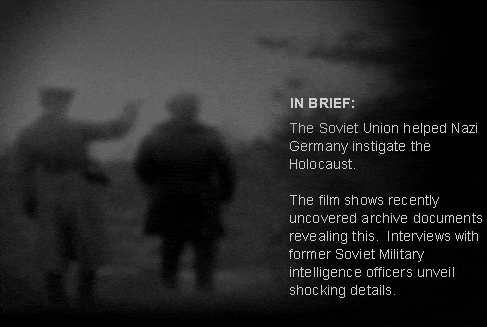
“The Soviet Story” is a story of an Allied power, which helped the Nazis to fight Jews and which slaughtered its own people on an industrial scale. Assisted by the West, this power triumphed on May 9th, 1945. Its crimes were made taboo, and the complete story of Europe’s most murderous regime has never been told. Until now…
AWARDS
“Mass Impact Award” – Boston Film Festival (Sept., 2008)
SYNOPSIS
The film tells the story of the Soviet regime.
- The Great Famine in Ukraine (1932/33)
- The Katyn massacre (1940)
- The SS-KGB partnership [in the late 1930s the KGB was called NKVD, more info>]
- Soviet mass deportations
- Medical experiments in the GULAG.
These are just a few of the subjects covered in the film.
“The Soviet Story” also discusses the impact of the Soviet legacy on modern day Europe. Listen to experts and European MPs discussing the implications of a selective attitude towards mass murder; and meet a woman describing the burial of her new born son in a GULAG concentration camp.
FILM FACTS
Title: “The Soviet Story”
Type: Documentary film
Genre: History, politics
Director: Edvins Snore
Language: English
Length: 85 min.
Date of production: 2008
”The Soviet Story” was filmed over 2 years in Russia, Ukraine, Latvia, Germany, France, UK and Belgium. Material for the documentary was collected by the author, Edvins Snore, for more than 10 years. As a result, ”The Soviet Story” presents a truly unique insight into recent Soviet history, told by people, once Soviet citizens, who have first hand knowledge of it.
Unique video footage
Rare footage shot in 1990, the last year of the USSR, shows an abandoned Soviet death-camp in Magadan, Siberia, where the KGB had carried out medical experiments on prisoners.
The film also presents never before broadcast-ed Nazi footage showing Soviets helping Hitler launch WW2 and providing aid for the Nazi Blitzkrieg.
Exclusive images
”The Soviet Story” features a number of photographs taken by Heinrich Hoffmann, Hitler’s personal photographer. These pictures have never before been shown to the public.
The film also presents several shocking Nazi documents found by the film’s author in the Political Archive of the German Foreign Ministry (2007).
PEOPLE IN THE FILM
The film crew interviewed more than 20 experts – leading Western and Russian historians, members of the European Parliament, a Soviet Secret agent, a Soviet military intelligence colonel, Soviet dissidents, GULAG inmates, as well as victims of the Famine-Genocide, deportations and of other Soviet crimes.
Norman Davies
Historian, Professor, Cambridge University:
”People were being shot day and night throughout the biggest country in the world. Stalin even got to the point of killing people by random, by quotas.”
Mikhail Gorbachev
Soviet president:
“Stalin was awash in blood! I saw the death sentences, which he signed in packages!”

Emma Korpa
GULAG survivor:
“Children were not considered inmates, so they were buried in a civilian graveyard.”
Ģirts Valdis Kristovskis
Member of the European Parliament:
“Europe continues to ignore Soviet crimes, mass murders, while millions of the victims are neglected.”
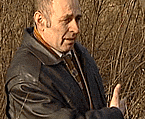
Volodimir Sergiychuk
professor, University of Kyiv:
“This is a sacred place for me. Because it is the resting place of the Famine victims, including my grandmother…”
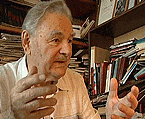
Vladimir Karpov
former Soviet Colonel [of Military intelligence – GRU]:
”Khrushchev was allowed to kill 7 or 8 thousand „enemies”. He asked: “Please increase my quota to 17 000!”
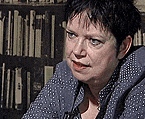
Françoise Thom
professor of Modern History, Sorbonne
”Stalin authorized children to be shot from the age of twelve!”
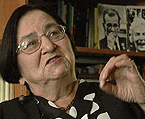
Natalia Lebedeva
historian, Institute of General History, RAS, Moscow:
”If a regime is criminal, then it acts criminally in all areas, including foreign affairs.”
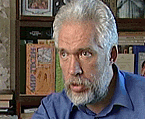
Boris Sokolov
professor, Moscow State Social University:
”Nobody wants to admit that one’s ancestors were simple criminals.”
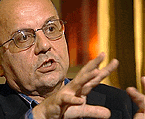
Viktor Suvorov
former Soviet Secret Agent:
“A delegation of German Gestapo and SS came to the Soviet Union to learn how to build concentration camps.”
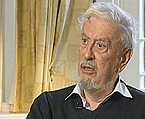
George Watson
literary historian, Cambridge University:
“Marx and Engels called Basks, Bretons, and Serbs – „racial trash”, Voelkerabfall.”
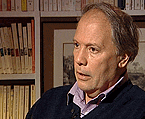
Nicolas Werth
historian, co-author of “The Black book of Communism”:
“Yes, people were killed by bullet in the head. We know that usually they were killed by bunches of between one hundred and several hundreds every night.”
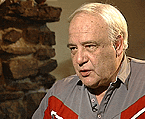
Vladimir Bukovsky
former Soviet dissident:
”Stalin exiled about a dozen of nations completely. Part and parcel. Chechens, Ingush, Kalmiks, Karachaevs, Crimean Tatars. A dozen of nations completely wiped out!”
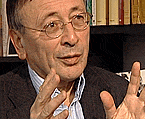
Pierre Rigoulot
historian, Institut d’histoire Sociale, Paris:
”French Communist party say today that they were resistant well before June 1941, when Soviet Union was attacked. In fact, they were in fight with marshal Peten’s government more than the German.”

Inese Vaidere
Member of the European Parliament:
”The Soviet Union transferred a lot of ethnic Russians into the occupied Baltic countries. It was a clear violation of Geneva Convention.”
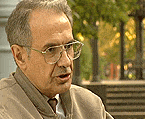
Sergey Sluch
historian, Institute of Slavic Studies, RAS, Moscow:
”According to all norms of international law, the decision of the Soviet Government to invade Poland [in 1939] was a clear act of aggression.”
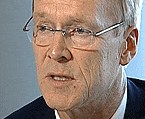
Ari Vatanen
Member of the European Parliament:
”My father lost four of his brothers in that war. Four! That was the price we paid that we did not have a democratic society next to us.”
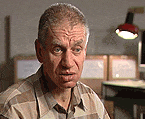
Alexander Guryanov
“Memorial” society, Moscow:
”In the 1930s the technology of murder and executions was introduced. Every administrative region had a designated area where corpses were to be buried.”
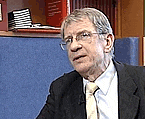
Wojciech Roszkowski
Member of the European Parliament:
”Russian identity has been shaped up by the sense of being part of a big empire.”

Michael Gahler
Member of the European Parliament:
”There is a equal right for all the victims to see those who committed crimes to see them tried and sentenced.”
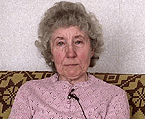
Rita Papina
survivor of Soviet terror:
”It is hard to speak about it. It is as if a scar was torn and is bleeding again.”
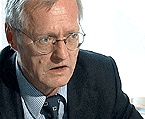
André Brie
Member of the European Parliament :
”Russia as a successor of the Soviet Union is obliged to carry out a real investigation of the crimes and the character of their system.”
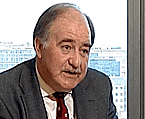
Christopher Beazley
historian, Member of the European Parliament:
”The agreement, which Stalin made with the West affected the whole of Europe for the next 50 years.”
FILM SPONSORS

UEN
The main sponsor of ”The Soviet Story” production was the UEN Group in the European Parliament, which supported the film based on a proposal by the members of the European Parliament – Girts Valdis Kristovskis and Inese Vaidere. ”The Soviet Story” was also supported by: Riga City Council , and “Tēvijas Sargs”.